
Z47
January 14, 2026

The formula for India’s AI moment is DPI^AI

This February, India hosts the India AI Impact Summit. It now sits alongside Bletchley Park (2023), Seoul (2024), and Paris (2025) as the conversation around AI shifts from theory to application. As the world moves forward from talking about what might go wrong with AI, it is replaced with a focus on what (actually) gets built, especially in countries where scale is not an option. 

That makes it the right moment to launch our new series, Intelligent Indians! with Shri Abhishek Singh, CEO of the India AI Mission. Intelligent Indians is a living chronicle of India’s AI rise, its builders, its breakthroughs, and our national AI ambition.  

Even before AI, India never had the luxury of building for everyone. With 1.4 billion people, the average is often the conventional edge case. Aadhaar, UPI, DigiLocker, and the DPI stack were all born from that constraint. The IndiaAI Mission carries the same DNA. The national AI bet is straightforward: build AI on top of DPI. Abhishek Singh calls it DPIAI

Across seven pillars, compute, datasets, skills, innovation, applications, startup financing, and safe, trusted AI, the IndiaAI strategy is clearly scoped and built for execution, with public-private partnerships.  
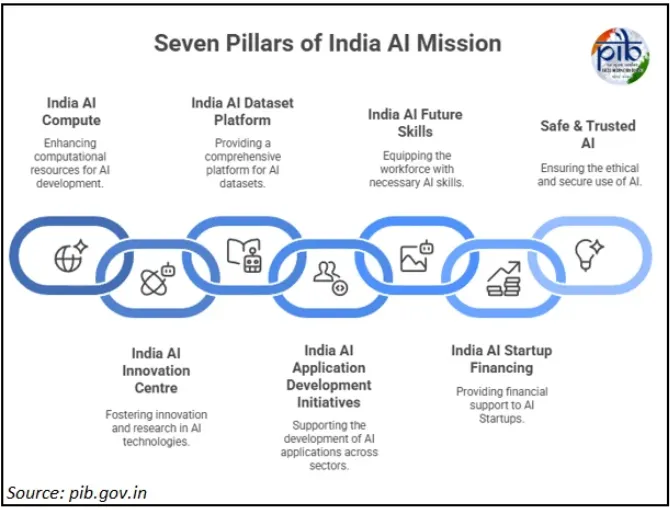
India’s language diversity makes the case for AI in governance and public sector applications obvious. We have twenty-two official languages, hundreds of dialects. If AI is to work for India, it must speak first. Voice is not a feature; it is the interface. Language and accessibility sit at the foundation of the Indian AI Mission.  

Compute is where most AI ambitions stall. India is trying to break that constraint early. Through incentives that pull in private capital and subsidize access for builders, the program has created capacity for roughly 38,000 GPUs at under $1 per GPU hour, well below global benchmarks. This lowers the barrier when deciding who gets to train models. 

The mission is opening up data too. AI Kosh now hosts more than 3,000 curated datasets for anyone building models or applications. Alongside this, teams are working on foundation models tuned to Indian languages and contexts. At population scale, that work can’t be outsourced. 

IndiaAI’s approach to applications follows the same logic. Healthcare. Agriculture. Governance. Climate. Education. Learning disabilities. These are not pilot projects; they are pressure points. Skilling runs in parallel, support for researchers across engineering, medicine, law, and public policy, and funding for data labs that employ the people who make large-scale AI possible. Annotation and evaluation are not footnotes. They are the next large opportunities. 

Agriculture shows why these matter. Farmers who lived near Krishi Vigyan Kendras always had an edge: better inputs, better advice, better timing. AI makes that advantage accessible to everyone. Any farmer should be able to ask a question by voice and get guidance in their own language. No travel. No hearsay. Agricultural guesswork gets replaced with scientific wisdom.  

What enables this is India’s structural edge: DPI paired with a consent-based data layer. Under the DPDP Act, applications can access the right data, with permission, to deliver services that are specific and timely. Farmers can see which subsidies or insurance schemes apply to them. Workers can understand healthcare or employment benefits they’re already eligible for. The answers exist because the rails are already in place. 

Education and healthcare mirror the pattern. Teacher shortages persist even in major cities. Most classrooms end up teaching to the top slice of students. AI tutors change the dynamic. They slow down. They repeat. They speak the student’s language. In healthcare, platforms like the Bharat Health Stack and Jan Aushadhi already cover millions. AI makes them usable, by voice, at scale, without friction. And this is what makes India's AI moment unique, that DPIAI rails exist for founders to build on.

The AI Summit isn’t just IndiaAI’s story, it is a landmark in India’s AI story. Nation first. Infrastructure-forward. Scaled to a billion users by default. Built to run in the real world, by Intelligent Indians!  
For more information, write to us: namaste@Z47.com.
Stay connected with Z47.

Watch more such podcasts

Z47
May 15, 2025

Unlocking Hypergrowth: How Great Products Sell Themselves

Z47
May 12, 2025

Founders, VCs , and the Art of Board Meetings 
by Tarun Davda

Z47
April 28, 2025

Shubham’s Journey: From APM to Product leader – A Handbook for Aspiring Product Professionals

Z47
January 14, 2026

The formula for India’s AI moment is DPI^AI

Article
Listen to article

This February, India hosts the India AI Impact Summit. It now sits alongside Bletchley Park (2023), Seoul (2024), and Paris (2025) as the conversation around AI shifts from theory to application. As the world moves forward from talking about what might go wrong with AI, it is replaced with a focus on what (actually) gets built, especially in countries where scale is not an option. 

That makes it the right moment to launch our new series, Intelligent Indians! with Shri Abhishek Singh, CEO of the India AI Mission. Intelligent Indians is a living chronicle of India’s AI rise, its builders, its breakthroughs, and our national AI ambition.  

Even before AI, India never had the luxury of building for everyone. With 1.4 billion people, the average is often the conventional edge case. Aadhaar, UPI, DigiLocker, and the DPI stack were all born from that constraint. The IndiaAI Mission carries the same DNA. The national AI bet is straightforward: build AI on top of DPI. Abhishek Singh calls it DPIAI

Across seven pillars, compute, datasets, skills, innovation, applications, startup financing, and safe, trusted AI, the IndiaAI strategy is clearly scoped and built for execution, with public-private partnerships.  

India’s language diversity makes the case for AI in governance and public sector applications obvious. We have twenty-two official languages, hundreds of dialects. If AI is to work for India, it must speak first. Voice is not a feature; it is the interface. Language and accessibility sit at the foundation of the Indian AI Mission.  

Compute is where most AI ambitions stall. India is trying to break that constraint early. Through incentives that pull in private capital and subsidize access for builders, the program has created capacity for roughly 38,000 GPUs at under $1 per GPU hour, well below global benchmarks. This lowers the barrier when deciding who gets to train models. 

The mission is opening up data too. AI Kosh now hosts more than 3,000 curated datasets for anyone building models or applications. Alongside this, teams are working on foundation models tuned to Indian languages and contexts. At population scale, that work can’t be outsourced. 

IndiaAI’s approach to applications follows the same logic. Healthcare. Agriculture. Governance. Climate. Education. Learning disabilities. These are not pilot projects; they are pressure points. Skilling runs in parallel, support for researchers across engineering, medicine, law, and public policy, and funding for data labs that employ the people who make large-scale AI possible. Annotation and evaluation are not footnotes. They are the next large opportunities. 

Agriculture shows why these matter. Farmers who lived near Krishi Vigyan Kendras always had an edge: better inputs, better advice, better timing. AI makes that advantage accessible to everyone. Any farmer should be able to ask a question by voice and get guidance in their own language. No travel. No hearsay. Agricultural guesswork gets replaced with scientific wisdom.  

What enables this is India’s structural edge: DPI paired with a consent-based data layer. Under the DPDP Act, applications can access the right data, with permission, to deliver services that are specific and timely. Farmers can see which subsidies or insurance schemes apply to them. Workers can understand healthcare or employment benefits they’re already eligible for. The answers exist because the rails are already in place. 

Education and healthcare mirror the pattern. Teacher shortages persist even in major cities. Most classrooms end up teaching to the top slice of students. AI tutors change the dynamic. They slow down. They repeat. They speak the student’s language. In healthcare, platforms like the Bharat Health Stack and Jan Aushadhi already cover millions. AI makes them usable, by voice, at scale, without friction. And this is what makes India's AI moment unique, that DPIAI rails exist for founders to build on.

The AI Summit isn’t just IndiaAI’s story, it is a landmark in India’s AI story. Nation first. Infrastructure-forward. Scaled to a billion users by default. Built to run in the real world, by Intelligent Indians!  

We are excited about the innovation and growth opportunities in this sector.

If you are considering building in the footwear space, we’d love to chat.
Drop us a line at consumer@matrixpartners.in

Learnt something new? Follow us!

Read Previous Article On Land & Expand
Read Next Article On Land & Expand